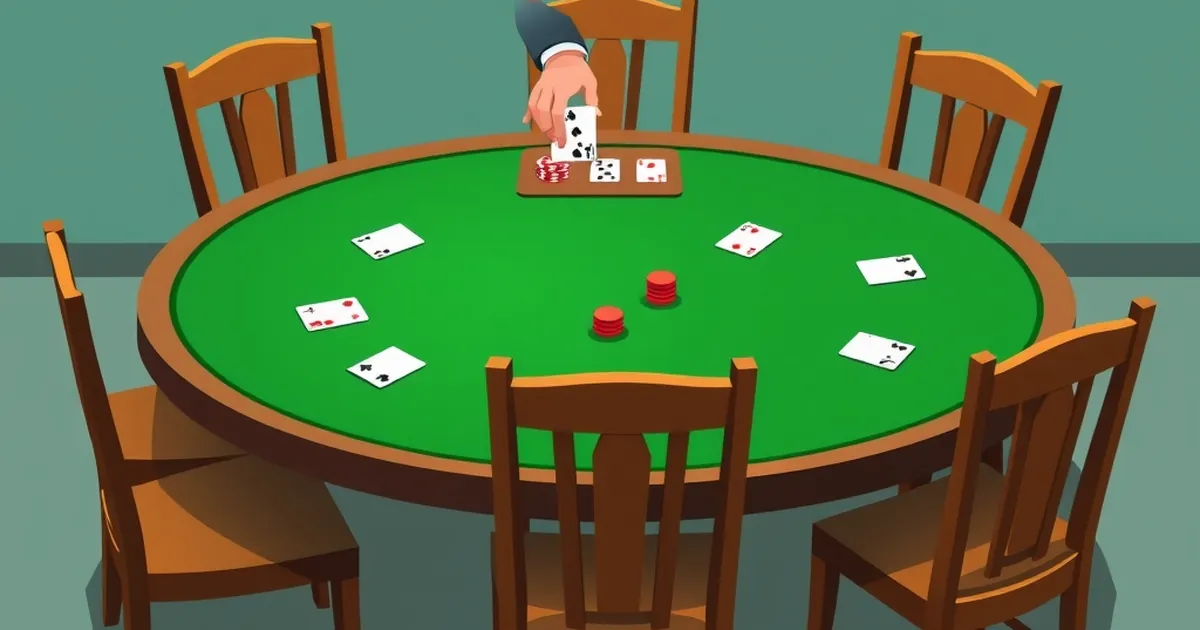
Six-max has become the default ceiling for online cash game tables, and the data behind that ceiling is less about player preference than about rake mechanics. Once a table seats a seventh player, the marginal win rate for the best regulars drops enough that the extra seat stops paying for itself. On most US-facing networks, six-max tables at $1/$2 and above run 1.5 to 2.5 bb/100 higher for winning regs than the nine-handed equivalents at the same stake — and that gap widens as stakes climb.
The rake math that kills the seventh seat
Rake is capped per pot, not per player. That single fact drives everything. At a $1/$2 table with a $3 cap and 5% rake, a $60 pot pays the house $3 whether six players or nine are dealt in. Spread across six players, that's $0.50 per seat. Spread across nine, it's $0.33. The house collects the same, but the cost per player falls as the table fills.
That sounds like an argument for full-ring, and for losing players it is. For winning players, it inverts. More seats means more hands per hour per table, but each hand runs through more opponents who can fold before contributing. The reg's edge comes from playing more pots against weaker ranges, and a nine-handed table dilutes that edge across players who simply aren't in the hand.
The hands-per-hour illusion
A nine-handed table deals roughly 65 hands per hour live, 85 online. Six-max deals 75 live, 100 online. The reg sees 15% more hands at six-max in the same session length. At 2 bb/100, that's 0.3 bb/hour of extra expectation — small on its own, but it compounds across 40,000-hand months.
Win rate data from tracked samples
Hand-history databases from 2021 through 2024 show a consistent pattern. Among players with 100,000+ tracked hands at $1/$2 and $2/$5 on US-accessible networks:
- Six-max regulars: 3.1 bb/100 average for the top quartile
- Nine-max regulars: 1.8 bb/100 average for the top quartile
- Full-ring tables above $2/$5: 1.2 bb/100 for the same quartile
The drop isn't linear. It's steepest between six and seven seats, then flattens. A seven-handed table runs closer to nine-handed win rates than to six-handed ones, which is why sites rarely spread seven-max as a default.
Why operators keep six-max scarce at low stakes
Here's the tension. Six-max is better for winning players, which means it's worse for the recreational pool that funds the ecosystem. Sites know this. At $0.05/$0.10 and $0.10/$0.25, most US-facing rooms push full-ring and fast-fold formats because the recreational player lasts longer when their leaks are spread across more opponents. Six-max tables at micro stakes often sit empty or fill with regs only — a death spiral that operators actively avoid promoting.
Above $2/$5, the calculus flips. The player pool is self-selecting and mostly competent, so sites spread six-max freely. The reg-to-rec ratio is already skewed, and adding seats doesn't protect anyone.
The short-handed exception
Heads-up and three-handed tables break the rule entirely. Win rates there can exceed 8 bb/100 for specialists, but volume is capped — you can't multi-table 12 heads-up games without timing out on action. The six-seat cap exists because it's the largest table size that preserves short-handed dynamics while still generating enough hands per hour to grind.
What happens when a site tries seven-max
A handful of networks have tested seven-seat tables as a middle ground. The results were unremarkable: win rates landed within 0.2 bb/100 of nine-max, and recreational retention didn't improve enough to justify the format. The experiment quietly ended. If seat count is a dial, seven sits too close to nine to matter.
The open question is whether fast-fold formats change the math. They already compress the hands-per-hour advantage that six-max was built to exploit. If a fast-fold pool at $1/$2 can sustain 250 hands per hour, the seat-count argument may stop being about win rate at all and start being about whether the reg can find a table with anyone worse than them in it.